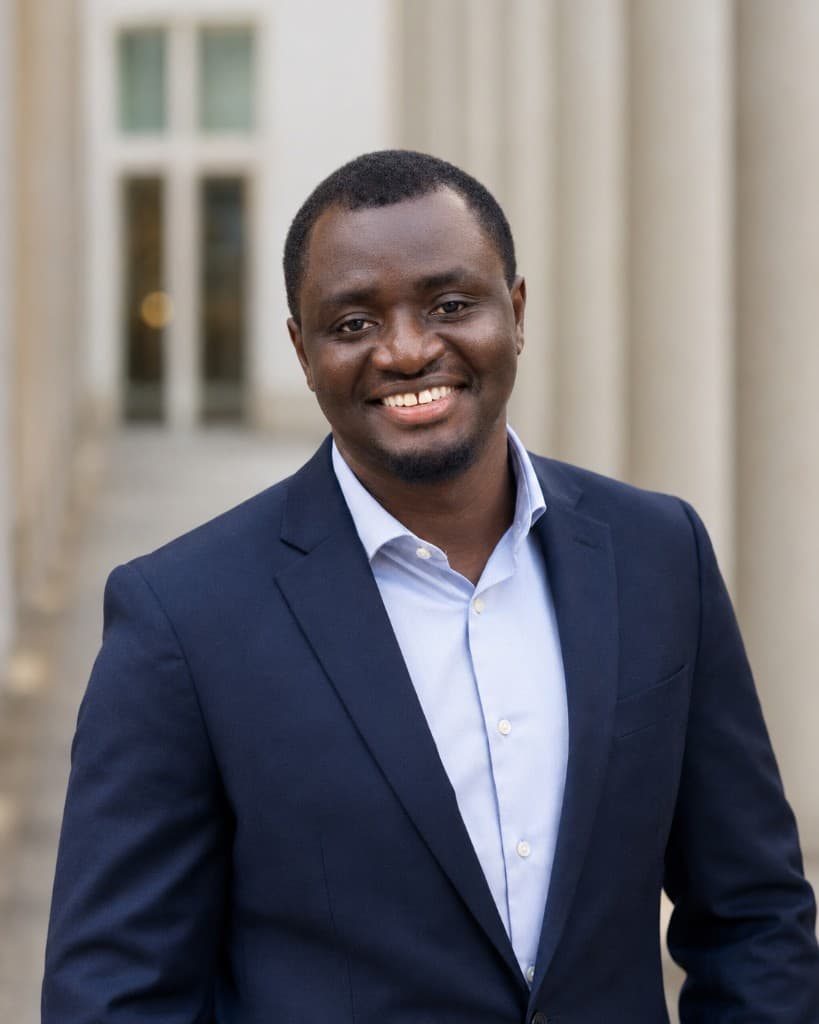
About
I like understanding how things work — and why people choose what they choose.
I'm a product manager with a background in mathematics, computer science, engineering, and business. My career has taken me from building and testing technology at Apple, to developer and cloud products at Microsoft, to business school, and now to consumer recommendations and personalization at Expedia Group.
My path
Engineering taught me how things work. Product taught me to ask what should exist.
I studied mathematics and computer science at Fisk University. The two still sit together in how I work. I want to be precise about what a system is doing, and precise about the question it is supposed to answer.
Apple was the first job. I interned in reliability testing across macOS and iOS, then worked on MacBook through the Apple Silicon transition, close to how a product is built, tested, and shipped. Microsoft moved me toward technical product management and the products developers use: APIs, connectors, and Azure Stream Analytics.
What I wanted next was the decision itself: who it is for, what should be built, and whether it worked once engineering, design, and data had a hand in it. I went to Emory's Goizueta Business School for an MBA in strategy and finance, and during school I was a senior product manager intern at ServiceNow.
Those were not unrelated jobs. The line runs from understanding systems, to building them, to deciding what they should do. I am now a product manager at Expedia Group on Trip Completion, working on personalization and recommendations that help travelers complete and enhance their trips.
Product
I want to be close to the user and close to the system.
The products I care about are the ones where a person's behavior, a product decision, and the system underneath all have to be held at once.
Start with the decision.
Understand what the person is actually trying to accomplish before deciding what technology belongs in the solution.
Understand the system.
A product manager does not need to be the engineer implementing every component. Enough technical understanding to reason about architecture, constraints, failure modes, and tradeoffs is what makes the judgment better.
Measure what actually happened.
A plausible product idea is not the same as a useful product. Experimentation, evaluation, and what people actually do should determine whether the product is working.
Build when possible.
Building products makes me better at product management. It forces decisions around scope, quality, latency, cost, the experience, evaluation, and what to do first, rather than leaving those ideas abstract.
Building
Sometimes the best way to understand a product problem is to build it.
I built Vybemovies because movie discovery is an interesting search and recommendation problem. A traditional catalog search works when someone knows what they want. It is much worse when the intent is harder to name.
The request
Something dark and cerebral, but not depressing.
Building it meant thinking through semantic retrieval, embeddings, vector search, and LLM reranking, then personalization and how to judge a result. That includes evaluation, NDCG, using an LLM as a judge, experimentation, and the tradeoff between relevance and latency. The case study is where the system is written down.
Curiosity
I'm drawn to products that have to understand people.
Search, recommendations, personalization, and the models behind them are interesting for a plain reason. A person may type only a few words, or take a few actions, and the product still has to infer the intent, find what might fit, rank it, and decide what to show.
That is where human behavior, product design, machine learning, information retrieval, experimentation, and judgment meet. I want to understand both the decision a person is making and the system that produced the answer.
Outside work
Curiosity doesn't stop at software.
There's usually something new I'm learning, making, or exploring.
- Cycling
- I ride for both transportation and recreation. Whether I'm commuting through Seattle or heading out on my road bike, cycling is one of my favorite ways to clear my head and explore.
- Hiking
- Living in the Pacific Northwest gives me plenty of reasons to get outside. I enjoy hiking, exploring new trails, and occasionally trading screens and city streets for mountains and trees.
- Golf
- I'm learning golf, which currently means spending more time working on my swing than worrying about my score. I enjoy the challenge of a game where small adjustments can make a surprisingly big difference.
- Art
- I've recently become more interested in art and art history. I enjoy learning about important works, the people who created them, and the history and ideas that give them context.
- Cooking
- I grew up with Ghanaian food and still love cooking it, but I also enjoy experimenting with dishes and techniques from other cuisines. Cooking for me is part tradition, part curiosity, and part experimentation.
- Watches
- I'm drawn to watches for their design, engineering, craftsmanship, and history. More than anything, I like the idea that an object can become tied to a particular chapter of your life and gain meaning through the memories attached to it.
Education
Education
Emory University, Goizueta Business School
M.B.A., Strategy, FinanceMay 2026Atlanta, GA
Fisk University
B.A., Mathematics and Computer ScienceMay 2017Nashville, TN
- Erastus Milo Cravath Full-Ride Presidential Scholarship
- Phi Beta Kappa Honor Society, Mortar Board Honor Society, and the Talented Tenth Leadership Program
What I'm working toward